This Week in British Banking: Tokenised Deposits, Stablecoin Rules and London’s On-Chain Shift
Britain’s digital money agenda is becoming a banking infrastructure story. This week, tokenised deposit trials, settlement research and stablecoin policy moved into closer alignment. From London, the important question is not simply what can move on a blockchain, but which institutions stand behind it when payments matter most in practice.

London, England
Nov 8, 2026
The week in brief
1–8 November 2026
Three developments shaped the week in British banking: preparations for a London summit on institutional blockchain infrastructure, Deutsche Bank’s assessment of digital asset adoption, and further policy work following the Autumn Budget.
The common thread was practical rather than speculative. Banks are examining how digital representations of money and securities could improve settlement, while policymakers are working through the conditions under which those arrangements can be trusted.
For London, that distinction matters. The opportunity is not simply to host more digital asset activity. It is to connect new payment technology to the legal, monetary and supervisory arrangements on which the City already depends.
1. Tokenised deposits move closer to core banking
The 6 November announcement of the speaker programme for The (un)Banked, reported by FF News, brought together representatives from the Bank of England, Barclays and HSBC. The lineup included Pavel Chichkanov, Barclays’ Ryan Hayward and HSBC’s Phoebe Zhou.
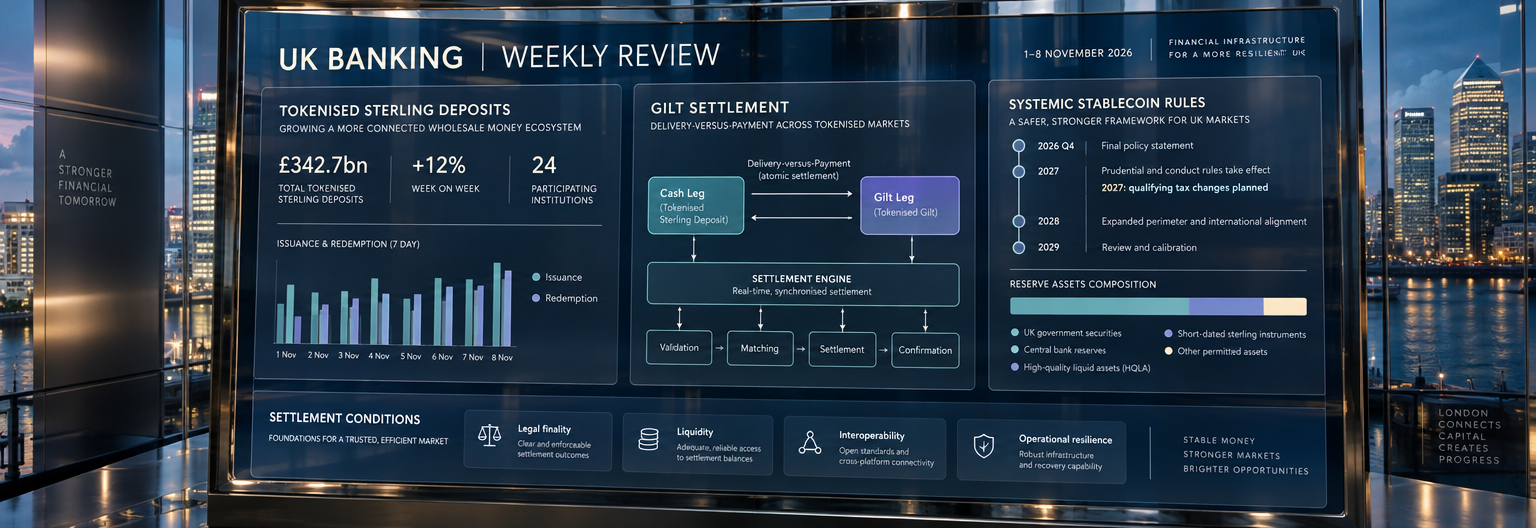
Alongside the event preparations, major UK lenders, including Lloyds Banking Group, accelerated testing of tokenised sterling deposits on public blockchains for sovereign debt and gilt settlement, following recent regulatory guidance.
The significance lies in the instrument being tested. A tokenised deposit remains a claim on a commercial bank. Its digital form may change how it is transferred or connected to a securities transaction; it does not, by itself, turn that deposit into central bank money or remove the issuing bank’s obligations.
For gilt markets, the attraction is a closer connection between the transfer of a security and its payment. Properly designed, this could reduce reconciliation work and the risk that one party delivers while the other does not.
Public blockchain infrastructure nevertheless introduces questions familiar to any regulated market: who can transact, how transfers are controlled, what happens during disruption, and when settlement becomes legally final. Those are design requirements, not details to settle after a successful demonstration.
2. Deutsche Bank puts settlement mechanics in focus
Deutsche Bank’s 4 November research in flow examined bank adoption of digital assets following Sibos. Sabih Behzad, its Head of Digital Assets & Currencies Transformation, highlighted the shift towards atomic settlement, live tokenised deposits and connections between private stablecoins and regulated bank tokens.
Atomic settlement means that linked transfers complete together, or neither completes. That can reduce the exposure created when the two sides of a transaction settle at different times.
It is not, however, a promise of costless liquidity. A system requiring cash and securities to be available immediately can place greater funding demands on participants than one that allows obligations to be netted before settlement.
The useful comparison is therefore not simply instant versus slow. It is the overall combination of speed, funding needs, resilience and cost.
Interoperability matters for the same reason. A bank token that works efficiently inside one platform has limited value if customers must repeatedly convert it to reach another. Connecting systems requires agreement on the claims being transferred, not merely a technical bridge between networks.
3. Stablecoin policy moves towards implementation
Following the 2 November Autumn Budget updates, the government confirmed plans to eliminate Capital Gains Tax on qualifying stablecoins and DeFi liquidity arrangements from 2027.
The word qualifying carries weight. The planned changes should not be read as a blanket exemption for all digital assets or every transaction involving decentralised finance. Their practical effect will depend on the scope and conditions of implementation.
The potential payments benefit is straightforward: reducing tax friction can make an eligible instrument easier to use. But tax treatment does not determine whether that instrument is safe to hold or reliable to spend.
Work on the draft Code of Practice for systemic stablecoins therefore matters more fundamentally. Reserve quality, redemption arrangements, operational continuity and the treatment of customers during failure will help determine whether a sterling stablecoin can function as dependable payment money.
Alongside that work, the Digital Securities Sandbox provides a controlled route for testing changes to securities market infrastructure. The two policy strands are connected, but distinct: testing a settlement arrangement is not the same as establishing the safeguards for a widely used payment instrument.
What to watch next
The next useful milestones are less about additional announcements and more about operating evidence:
- Settlement: Can tokenised cash and gilts move together with clear legal finality?
- Liquidity: Do faster transfers reduce total costs once funding requirements are included?
- Interoperability: Can institutions connect different forms of digital money without obscuring their different risks?
- Safeguards: Are redemption rights and disruption procedures clear enough for routine use?
The week’s direction was towards institutional adoption. Its eventual importance will depend on whether the technology improves payments and settlement without weakening confidence in the money moving through them.