This Week in Canadian Banking: Ottawa Sets Out Stablecoin Rules and a New Role for the Bank of Canada
Ottawa’s stablecoin proposal was the defining Canadian banking development this week. Its central bargain is straightforward: give digital payment instruments room to grow, but require credible backing and dependable redemption. For banks and non-bank issuers alike, the details now matter more than the promise of faster, cheaper payments alone does.

Ottawa, ON
Oct 25, 2026
Canadian banking weekly: October 18–25, 2026
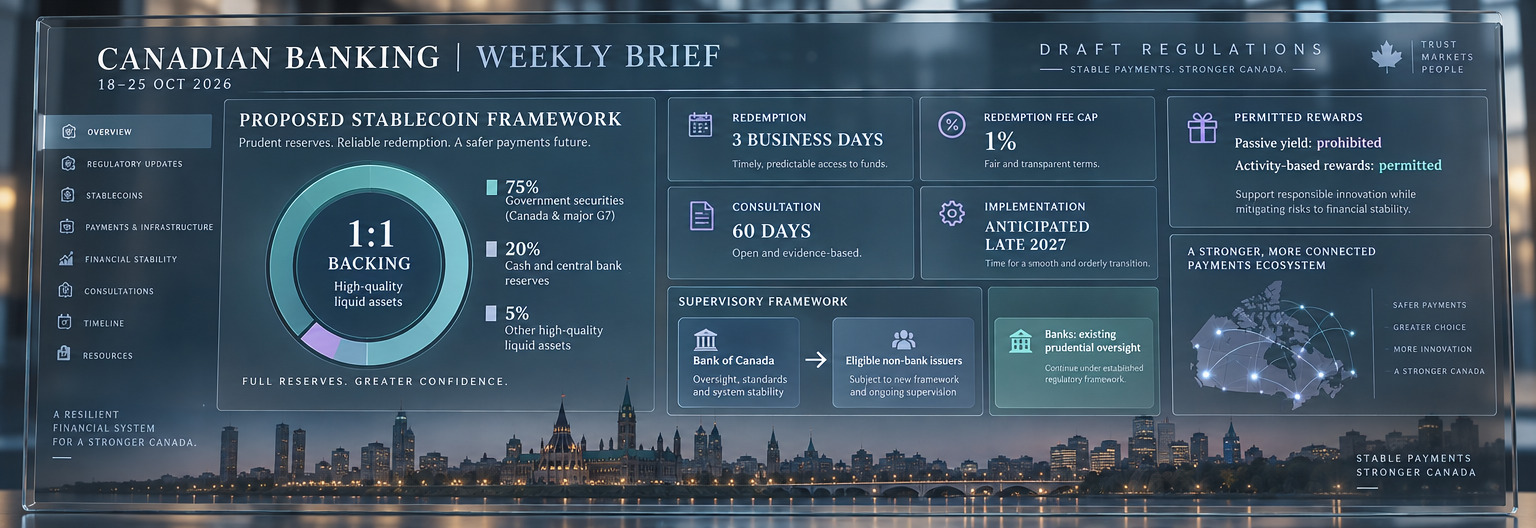
Canada’s stablecoin policy moved from broad direction to operational detail this week. On October 23 and 24, Ottawa published draft regulations under the Stablecoin Act, opening a 60-day consultation ahead of anticipated implementation in late 2027.
For Ottawa’s financial-policy community, the significance is not simply that digital assets are receiving more rules. It is that the proposed framework identifies who would supervise eligible issuers, what must support their tokens and how quickly holders should be able to get their money back.
The approach leaves room for payment innovation while putting the central question first: can a stablecoin reliably deliver the value it promises?
1. The Bank of Canada gets a defined supervisory role
Under the proposed framework, the Bank of Canada would become the primary supervisor and registry authority for non-financial institutions issuing fiat-backed stablecoins across provincial or international borders.
A fiat-backed stablecoin is a digital token designed to maintain a fixed value against a conventional currency. Its reliability depends less on the technology recording transfers than on the assets and legal arrangements supporting that promise.
A defined supervisory home should help legitimate issuers understand the route to market. It should also make accountability clearer when an issuer falls short. Neither registration nor supervision, however, should be confused with a guarantee that a product cannot fail.
2. Reserve backing and redemption become the core tests
The draft’s principal operating requirements include:
- One-to-one reserve backing: outstanding stablecoins must be matched by reserves.
- High-quality liquid assets: backing must meet quality and liquidity requirements, with custody provided by Canadian-incorporated custodians.
- Redemption within three business days: holders must have a defined timetable for converting tokens back into conventional money.
- A one-per-cent ceiling on redemption fees: issuers would face a limit on what they can charge holders to exit.
These provisions address different risks. One-to-one backing concerns the amount of reserves. Asset quality and liquidity concern whether those reserves can deliver cash when needed. Custody concerns where the assets are held. Redemption rules determine how the promise reaches the customer.
The distinction matters because a token can move almost instantly while redemption takes considerably longer. Around-the-clock transferability is not the same thing as around-the-clock access to cash.
The fee ceiling also deserves attention. A maximum is not necessarily a competitive price: at the permitted ceiling, redeeming $10,000 would cost $100. Providers will still need to demonstrate that their products offer useful economics for payments.
3. Rewards receive a narrower opening
The Department of Finance also clarified its treatment of rewards: passive yields remain prohibited, but transaction- and activity-based rewards would be permitted.
In practical terms, the proposal distinguishes compensation for holding a balance from incentives for using a payment product.
That gives issuers some flexibility to encourage adoption without opening an unrestricted channel for yield-bearing stablecoins. The consultation should test how clearly that boundary can be drawn. A reward’s economic substance matters more than its marketing label.
4. Banks remain on a separate regulatory track
RBC, TD Bank Group, BMO and Scotiabank remain outside these particular non-bank issuer rules. Their blockchain and deposit-token initiatives continue under existing banking oversight, including OSFI supervision and the Bank Act.
That is a distinction between regulatory frameworks, not an exemption from oversight. It also means professional users should examine the legal claim behind each product rather than treating every digital token as interchangeable.
A bank-issued deposit token and a non-bank stablecoin may offer similar payment functions while presenting different contractual rights and risk exposures.
What to watch next
The consultation’s most useful work will be practical: testing reserve liquidity under stress, the mechanics of redemption, the clarity of customer disclosures and the boundary between rewards and passive yield.
The week’s takeaway: Ottawa is offering stablecoin innovation a more defined path, not a free pass. That is a constructive direction. Its success will depend on whether the final rules make the promise of stable value understandable—and dependable—when customers most need it.