This Week in European Banking: ECB Infrastructure, Digital Euro Plans and the Stablecoin Response
Europe’s digital-money ambitions acquired more concrete infrastructure this week. The ECB advanced the networks behind a digital euro, while private euro tokens strengthened their links to bank payments. Seen from Paris, these developments concern more than financial technology: they concern who will operate, regulate and ultimately anchor Europe’s money system.

Paris, France
Nov 8, 2026
The week’s main development: building the connections
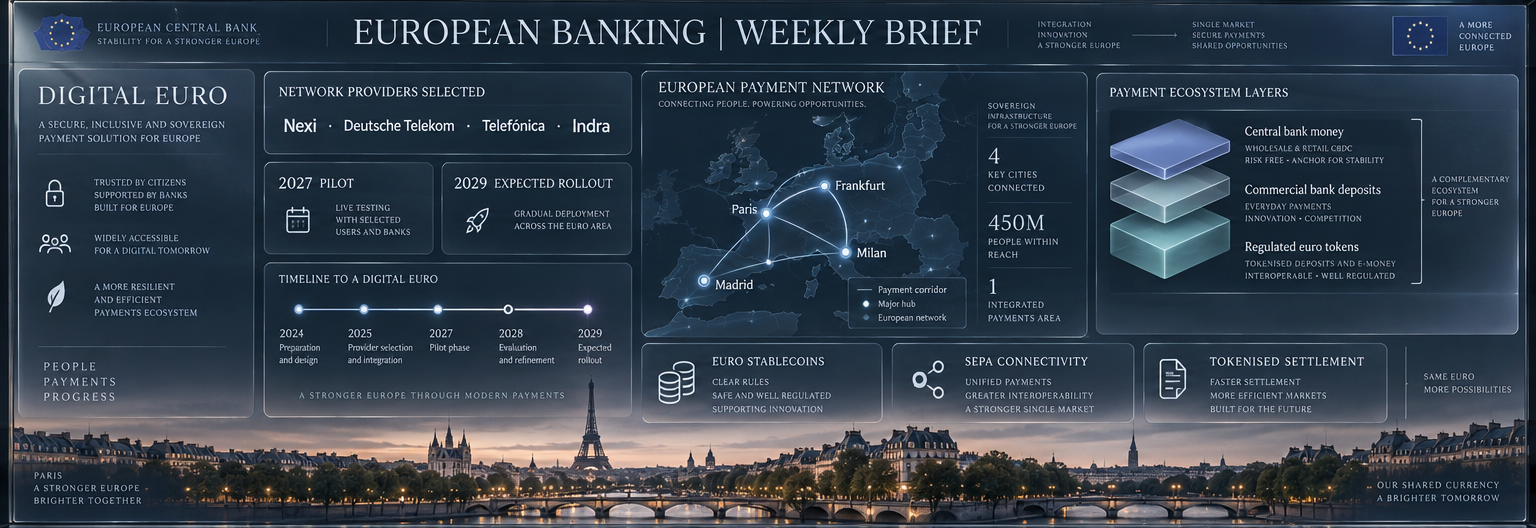
The ECB’s selection of network service providers on 2 November was the clearest sign this week that the digital euro is becoming an infrastructure programme rather than simply a monetary-policy proposal.
Technology groupings featuring Nexi Payments, Deutsche Telekom, Telefónica and Indra Group were selected to provide connectivity between national central banks and commercial payment service providers, according to FinTech Futures’ coverage.
Connectivity rarely attracts the attention given to a new currency or consumer app. Yet it determines whether a public payment instrument can function reliably across borders, institutions and competing commercial interfaces.
Seen from Paris, this is the practical substance of European financial sovereignty: not merely denominating payments in euros, but retaining the capacity to operate the networks through which those payments move.
Digital euro: a timetable, and a strategic purpose
On 5 November, ECB Executive Board member Piero Cipollone outlined a 12-month pilot beginning in 2027, ahead of an expected 2029 rollout, as reported by Bitcoin News.
His emphasis on monetary sovereignty gives that timetable its wider significance. If digital commerce increasingly relies on foreign platforms and dollar-backed stablecoins, Europe risks becoming a user of financial infrastructure whose commercial priorities and governance are set elsewhere.
A digital euro would provide a public-money anchor for digital payments. It would not, by itself, replace the need for competitive European payment services. Nor should it be confused with a general commitment to put retail payments on a blockchain: digital central bank money and distributed-ledger technology are distinct choices.
The policy test is therefore broader than technical readiness. Privacy, resilience, accessibility and the treatment of bank deposits will help determine whether the project strengthens trust without unnecessarily disrupting the institutions that finance the economy.
Private euro tokens: the bridge to bank accounts matters
The private-sector counterpart came with the 5 November launch of GateHub Euro, or EURGH, presented as MiCA-compliant and offering direct SEPA integration, according to U.Today’s report.
The important feature is the connection between blockchain transactions and ordinary euro payment accounts. A token becomes more useful when customers can move funds into and out of it without cumbersome banking arrangements.
Europe’s Markets in Crypto-Assets Regulation supplies the framework for bringing such activity within a common regulatory perimeter. But regulatory status is not the same as equivalence to central bank money. Users still need to understand the issuer, redemption arrangements and operational dependencies.
The constructive European response is neither to dismiss these products nor to treat their technology as sufficient proof of value. It is to make useful innovation compete on clear terms, with credible protections.
Banks and tokenisation: beyond another payment product
The ECB’s parallel discussion of asset tokenisation, including work involving Banca d’Italia, widened the week’s focus from retail payments to the organisation of financial markets.
Tokenised assets raise a fundamental settlement question: what money should move when a digital security changes hands? Central bank money, commercial bank deposits and regulated private tokens carry different claims and risks. Faster asset transfers offer limited progress if the accompanying cash arrangements remain fragmented or difficult to trust.
For banking groups preparing regulated stablecoin initiatives, including ING and CaixaBank, the challenge is consequently strategic as well as technical. Banks must consider where customer balances sit, who controls payment interfaces and how new settlement services fit their existing businesses. Banca Sella, also among the banks associated with this week’s coverage, belongs on that wider watchlist.
The European takeaway
This week connected three agendas too often discussed separately: public digital money, regulated private tokens and tokenised market infrastructure.
Europe should pursue them as complementary capabilities, not interchangeable products. A digital euro can preserve access to public money; private providers can develop useful services; common rules can make the resulting system more dependable across national borders.
The next measure of progress is not the number of announcements. It is whether Europe can turn these initiatives into interoperable services that people and businesses choose to use—while keeping the monetary anchor, legal accountability and essential infrastructure firmly within a credible European framework.