This Week in U.S. Banking: Digital-Dollar Consortia Advance as GENIUS Act Rules Sharpen the Business Case
This week, American banks made the business case for digital dollars more concrete: protect customer relationships, modernize settlement, and compete inside clearer regulatory boundaries. From Charlotte, the signal is institutional coordination. The test, however, remains operational: whether these networks deliver repeat usage, dependable redemption, and better economics for corporate clients.

Charlotte, NC
Nov 8, 2026
U.S. banking weekly review: November 1–7, 2026
From Charlotte, where banking strategy is closely tied to the economics of deposits, payments, and corporate relationships, this week’s digital-finance developments fit a familiar pattern. Established institutions are organizing around a new distribution and settlement technology without surrendering the customer relationship that makes their existing businesses valuable.
Three developments stood out: progress toward a shared bank-issued stablecoin, continued work on tokenized deposits and payment controls, and a clearer regulatory framework for reserve management. Together, they suggest that the next competitive phase will depend less on blockchain branding and more on execution.
1. The 21-bank consortium: a defensive strategy with an offensive opportunity
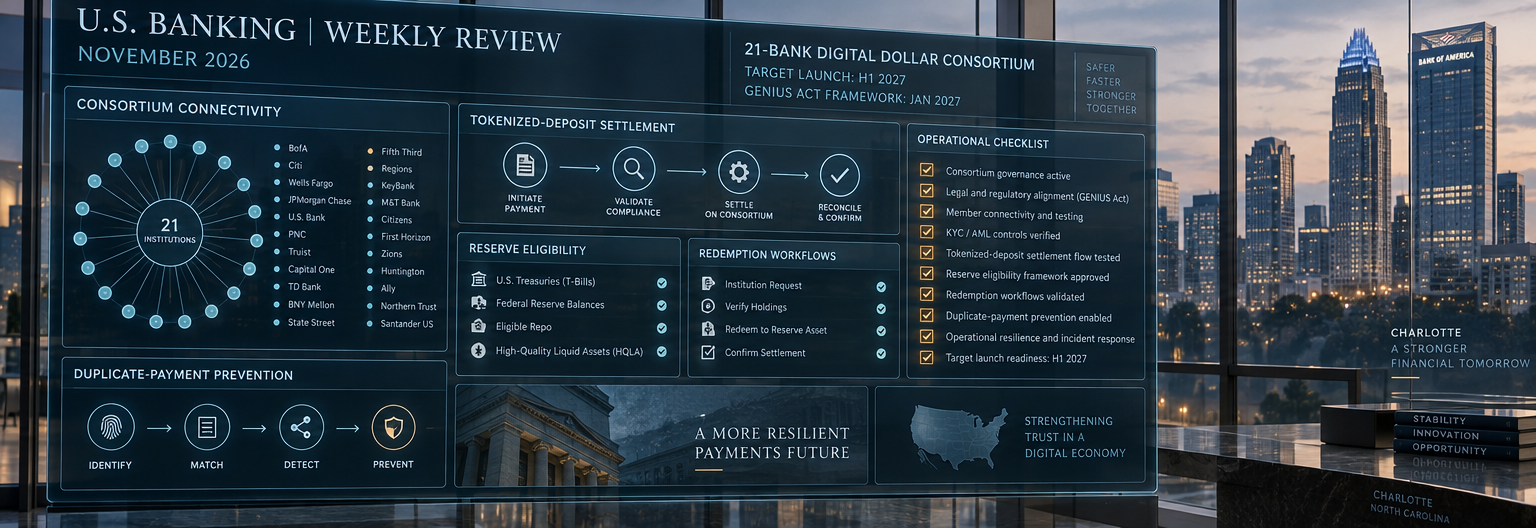
The consortium involving 21 banks, including Wells Fargo, Goldman Sachs, Bank of America, and Citi, advanced preparations for a shared dollar-pegged stablecoin targeted for the first half of 2027.
Wells Fargo’s launch timeline provides the scheduling anchor. Analysis published November 4 lays out the strategic incentive: compete with nonbank stablecoins such as Circle’s USDC while retaining more of the associated customer activity and payment economics within the banking system.
That is a credible institutional motivation. When corporate clients move money onto another issuer’s payment network, banks risk losing more than transaction fees. They can also lose visibility into customer workflows and opportunities to provide liquidity, foreign exchange, and treasury services.
A shared instrument offers a way to respond collectively rather than asking customers to navigate a separate token at every bank. It also creates governance work: participating institutions must align on access, redemption, compliance responsibilities, and commercial terms.
What matters next: Twenty-one participating banks represent distribution potential, not yet customer adoption. The meaningful measures will be active corporate users, recurring payment flows, redemption performance, and the cost of integrating the network into existing treasury systems.
There is also an important balance-sheet distinction. Keeping activity inside a bank-led network does not automatically mean preserving conventional deposits dollar for dollar. The issuer structure and reserve arrangements will determine where the funding benefits actually accrue.
2. Tokenized deposits: a separate route to modernizing bank money
Stablecoins were only one part of the week’s institutional picture. A November 6 sector brief highlighted commercial use of JPMorgan Chase’s Kinexys infrastructure and JPMD tokenized deposits on public and Layer-2 blockchains. It also described regional banks testing shared tokenized-deposit rails with Cari ahead of targeted late-2026 deployment.
The distinction matters. A tokenized deposit represents a bank deposit through a different technical architecture; a payment stablecoin has its own issuance, reserve, and redemption structure. Similar interfaces do not make the underlying claims interchangeable.
For institutions, tokenized deposits offer a potentially attractive proposition: introduce programmable settlement while preserving a direct banking relationship. Regional-bank collaboration is particularly relevant because shared infrastructure can spread development costs and reduce the burden of building an independent network.
What matters next: The practical benchmark is whether customers can complete useful transactions with fewer manual steps, more flexible settlement, or better cash visibility. Moving an existing process onto a blockchain without improving those outcomes is not a compelling operating model.
3. Duplicate-payment prevention becomes a core product requirement
The operational story was equally important. PYMNTS’ November 6 coverage examined automated reconciliation designed to prevent duplicate payments across institutional stablecoin rails.
This is precisely the kind of infrastructure work that deserves attention. A payment instruction can pass through a corporate system, a bank interface, a blockchain transaction, and an internal ledger. A delayed confirmation or an automated retry must not turn one business obligation into two transfers.
Reliable service therefore requires controls that recognize repeated instructions, reconcile transaction status, and route exceptions for resolution. Faster settlement does not eliminate those responsibilities; it can make mistakes harder to unwind.
What matters next: Banks should assess exception rates, reconciliation time, duplicate-payment incidents, and manual intervention alongside transaction speed. For corporate treasurers, a dependable audit trail is part of the product—not an optional compliance layer.
4. GENIUS Act rules make reserve management a competitive issue
The regulatory anchor was the OCC’s finalized GENIUS Act framework, effective January 2027. BPI’s reserve-requirements analysis and November 7 weekly briefing emphasized that only a small subset of dollar stablecoins currently satisfy the strict bank-grade liquid-reserve standards discussed in its assessment.
For bank issuers, the opportunity is to turn established capabilities in liquidity management, controls, and supervision into a credible institutional service. Those capabilities are expensive, but they are also difficult to reproduce quickly.
Compliance is not an automatic commercial victory, however. Reserve requirements affect economics, while onboarding, integration, and redemption determine whether a compliant product is useful. Banks will still need to compete on service quality and network reach.
What matters next: Evaluate reserve eligibility, liquidity, redemption arrangements, and issuer economics together. Regulatory standing and operational resilience are related, but neither should be treated as a substitute for the other.
Bottom line
This week strengthened the case that traditional financial institutions will remain central to digital finance. They bring corporate distribution, treasury relationships, and the operational capacity to support regulated money movement.
From a Charlotte banking perspective, the strongest signal is not that institutions are adopting blockchain terminology. It is that they are coordinating issuance, testing deposit infrastructure, and addressing the controls required to make digital settlement usable.
The next test is measurable adoption: repeat customers, recurring flows, reliable redemption, and demonstrably better operating outcomes. That is where an institutional initiative becomes financial infrastructure.