This Week in U.S. Banking: Tokenized Deposits Expand as Stablecoin Rules Take Shape
This week, American banks pushed digital finance deeper into institutional payments, retail deposits, and community-bank settlement. From Charlotte, the important development is not the multiplication of tokens. It is the emerging competition to make regulated banking relationships more useful, more portable, and less expensive to operate without sacrificing customer protections.

Charlotte, NC
Oct 25, 2026
Weekly overview: October 18–25, 2026
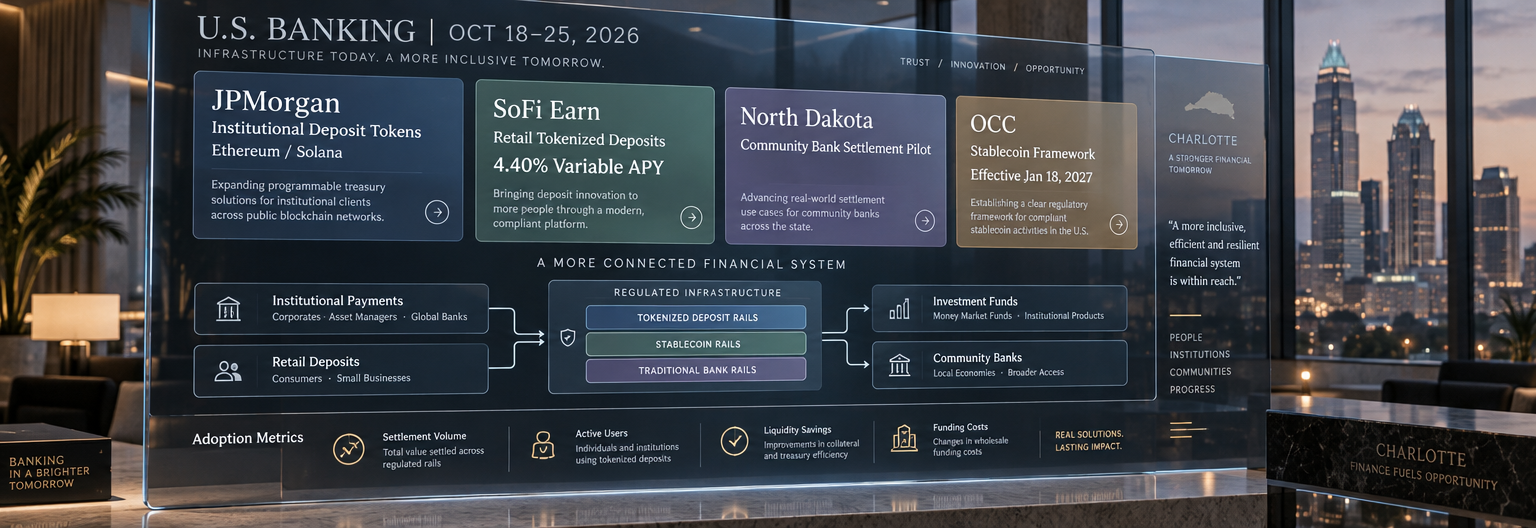
American banking’s digital-asset agenda advanced across three business lines this week: institutional transaction services, retail deposit gathering, and interbank settlement. Alongside those commercial developments, the Office of the Comptroller of the Currency finalized its implementation framework for the GENIUS Act.
From Charlotte, where banking is an operating industry rather than an abstract disruption thesis, the pattern looks familiar. Established institutions are adopting new infrastructure while trying to preserve the advantages that already support their franchises: customer trust, regulated balance sheets, compliance capabilities, and distribution.
That is a credible strategy. Whether it becomes a profitable one depends on usage, not launch announcements.
JPMorgan: broader distribution, distinct businesses
On October 19, JPMorgan expanded its USD-denominated deposit token, JPM Coin (JPMD), to the public Ethereum mainnet. On October 22, J.P. Morgan Asset Management extended tokenized money-market offerings—including the My OnChain Net Yield Fund (MONY) and JPMorgan OnChain Liquidity-Token Money Market Fund (JLTXX)—to Solana through Morgan Money. See JPMorgan’s Kinexys digital-payments platform.
The historical context matters. JPMorgan launched JPM Coin in 2019 for institutional clients, initially supporting payments and transfers between accounts at the bank. Expanding blockchain access builds on that transaction-banking foundation rather than creating a banking business from scratch.
The deposit token and the investment funds nevertheless serve different purposes. A bank deposit supports payments and cash management. A money-market fund is an investment product. Putting both on blockchain infrastructure does not make their legal claims, risks, or customer uses interchangeable.
Business-model implication: JPMorgan is positioning itself to retain the institutional client relationship across payments, liquidity management, and investment allocation. Wider network availability could make those services accessible within more digital workflows.
What to measure: recurring client activity, payment value, fund assets, redemption performance, and whether customers can move between operational cash and investments with fewer manual steps. Additional blockchain support matters only if it improves those outcomes.
SoFi: a retail deposit proposition with a transfer option
On October 22, SoFi Bank announced SoFi Earn (SOFIE), marketed as the first national bank-issued tokenized deposit designed directly for retail consumers. The offering launched with a 4.40% variable APY and standard FDIC insurance eligibility, alongside the ability to convert balances 1:1 into SoFiUSD for round-the-clock blockchain transfers. See the SoFi launch announcement.
The commercial proposition combines two familiar customer priorities: earning interest on cash and moving money when needed. Blockchain is the delivery mechanism, not the underlying reason someone maintains a balance.
The important boundary is between the deposit and the stablecoin. FDIC eligibility for a qualifying bank deposit should not be read as blanket insurance for a separate stablecoin holding. Clear disclosures at conversion are therefore part of the product’s operating requirements, not a secondary communications task.
Business-model implication: SoFi is competing for primary cash balances while offering an additional transfer channel. Success would mean customers keep useful balances at the bank and use the transfer functionality for practical purposes—not simply move funds in response to an introductory yield.
What to measure: retained balances, acquisition costs, conversion frequency, support costs, and deposit sensitivity when the variable APY changes.
Community banks: shared infrastructure gets a practical test
Gate City Bank announced on October 19 that it had joined the Bank of North Dakota’s Roughrider Coin pilot. The initiative uses Solana for near-instant interbank settlement and liquidity transfers, with Fiserv involved as a technology partner and VersaBank USA acting as issuer. Relevant institutional resources include Gate City Bank and the Bank of North Dakota.
For smaller institutions, the appeal is less about creating a proprietary digital-asset franchise than accessing infrastructure they could not economically build alone.
Shared settlement capabilities could help participating institutions move liquidity more efficiently. But faster transfers do not automatically produce lower total costs. Integration, reconciliation, compliance, exception handling, and liquidity coverage still require resources.
What to measure: participating institutions that transact regularly, settlement reliability, reconciliation workload, and demonstrable reductions in liquidity friction. Joining a pilot is an initial milestone; embedding it in daily treasury operations is the more meaningful one.
Regulation: clearer requirements, persistent funding tensions
On October 21, the OCC issued its final rule implementing the Guiding and Establishing National Innovation for U.S. Stablecoins Act. News Release 2026-92 outlines capital floors and reserve requirements effective January 18, 2027, while retaining case-by-case review of third-party yield arrangements. The agency’s releases are available through its newsroom.
The American Bankers Association and Bank Policy Institute raised concerns about deposit migration toward nonbank crypto platforms.
Those concerns reflect both institutional self-interest and a legitimate funding question. Deposits support bank lending and liquidity management. If competing arrangements attract balances through yield or convenience, banks may face higher funding costs or less predictable deposit behavior.
At the same time, protecting the deposit franchise cannot substitute for improving its utility. Banks have a stronger case when they pair regulatory consistency with better payment access, transparent pricing, and competitive service.
Bottom line for the week
Traditional financial institutions remain central to this phase of digital finance. They are issuing products, distributing investments, organizing settlement networks, and negotiating the regulatory perimeter.
The next distinction is between genuine adoption and blockchain branding. The scorecard should be operational: repeat customers, meaningful transaction volumes, reliable redemptions, lower processing costs, and manageable liquidity demands. If those measures improve, tokenization becomes banking infrastructure. If they do not, it remains an additional technology layer looking for a durable business case.