This Week in UK Banking: Tokenised Collateral, Digital Deposits and HSBC’s Stablecoin
This week’s banking developments point towards a more institutional phase of digital finance. Britain is setting conditions for tokenised collateral and advancing bank deposit settlement, while HSBC is taking a stablecoin to existing customers in Hong Kong. The question is whether these systems improve finance without weakening its essential safeguards.
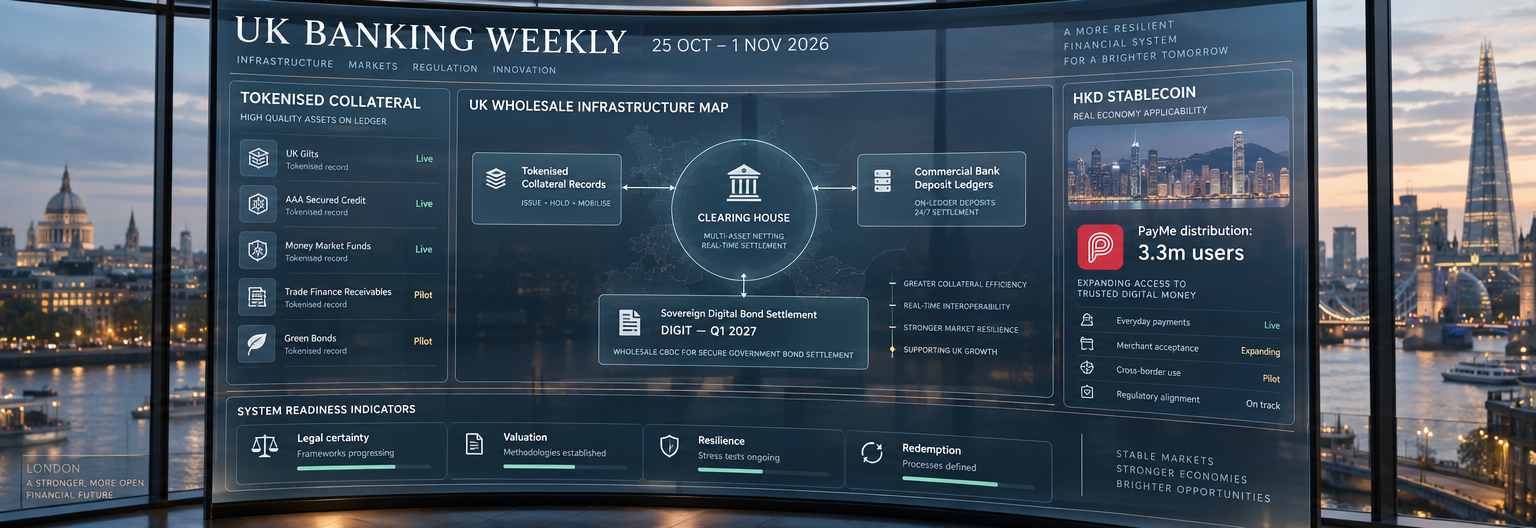

London, England
Nov 1, 2026
The week in brief
25 October–1 November 2026
Three developments stood out this week: the Bank of England’s proposed approach to tokenised collateral in central clearing; further work by major British lenders on tokenised deposits; and HSBC’s Hong Kong dollar stablecoin rollout.
From London, the connecting theme is institutional rather than technological. Digital records may change how money and securities move, but the decisive questions remain familiar: what does the holder own, who must honour the claim, and will the arrangement work under stress?
1. Tokenised collateral: the Bank sets out its expectations
On 29 October, the Bank of England published a consultation outlining draft supervisory expectations for central counterparties seeking to accept tokenised forms of eligible collateral under the forthcoming UK CCP Rulebook.
Central counterparties stand between buyers and sellers in financial markets. The collateral they collect helps protect the system if a participant fails to meet its obligations. Changing how that collateral is recorded therefore has consequences well beyond administrative efficiency.
Deputy Governor for Financial Stability Sarah Breeden’s message was that the existing framework does not prevent tokenisation, provided the collateral meets requirements for resilience, valuation and legal settlement.
The important distinction is between an asset and its digital representation. Putting a security on a distributed ledger does not, by itself, make it more creditworthy, easier to sell or legally simpler to seize following a default. Those properties still need to be established.
Why it matters: the consultation gives clearing infrastructure a route towards adoption without treating a new recording system as a substitute for established safeguards. Faster transfers are useful only if clearing houses can reliably value, control and realise the collateral they receive.
Source: Bank of England consultation on tokenised collateral in central clearing.
2. Tokenised deposits: British banks work on the settlement layer
Barclays, Lloyds Banking Group, NatWest and HSBC UK advanced work stemming from the Great British Tokenised Deposit initiative. Preparations for Q1 2027 sovereign digital bond pilots under DIGIT, alongside HM Treasury, give that work a practical focus.
A tokenised deposit is commercial bank money represented on a digital ledger. It remains a claim on the issuing bank; the technology changes how that claim can be recorded and transferred.
That distinguishes it from a non-bank stablecoin, whose holder’s rights depend on the issuer’s legal structure, backing assets and redemption terms. Neither category should be assessed by its label alone.
For digital bonds, the settlement asset matters as much as the security. Recording a bond on a ledger achieves only part of the potential benefit if the payment must still travel through a separate process requiring reconciliation. Coordinating the transfer of the bond and its payment could reduce the risk that one party delivers while the other does not.
Why it matters: the British banks are pursuing a route that keeps commercial bank money central to digital settlement. The practical test will be whether their arrangements work across institutions, rather than creating separate systems that cannot readily exchange value.
Further background: UK Finance.
3. HSBC in Hong Kong: distribution brings a different test
HSBC’s end-of-October rollout of its Hong Kong dollar-backed stablecoin, HSBC RedCoin (RCHKD), across 3.3 million PayMe users brought customer distribution into focus. The bank also outlined plans to enable tokenised asset investing on distributed ledgers before year-end.
The scale of the existing PayMe audience is significant, but availability should not be confused with active use. The next question is whether customers find a reason to hold or transfer the stablecoin rather than use familiar payment options.
The institutional questions are equally important: how redemption operates, what rights holders have, and how the stablecoin connects with bank accounts and investment services. Those arrangements determine whether a digital token functions as dependable money rather than simply another balance on a screen.
Why it matters for UK banks: Hong Kong offers a useful comparison, not a template to import unchanged. A bank’s distribution network can help a new payment instrument reach customers, but the surrounding monetary and regulatory framework determines what that instrument can safely do.
The London takeaway
This was a week of progress across three distinct layers: collateral, settlement money and customer payments. They are related, but they are not interchangeable.
For Britain, the opportunity is to connect tokenised assets with reliable money and enforceable legal rights. The measure of success will not be the number of tokens issued. It will be lower processing costs, less reconciliation, dependable settlement and confidence that survives difficult market conditions.